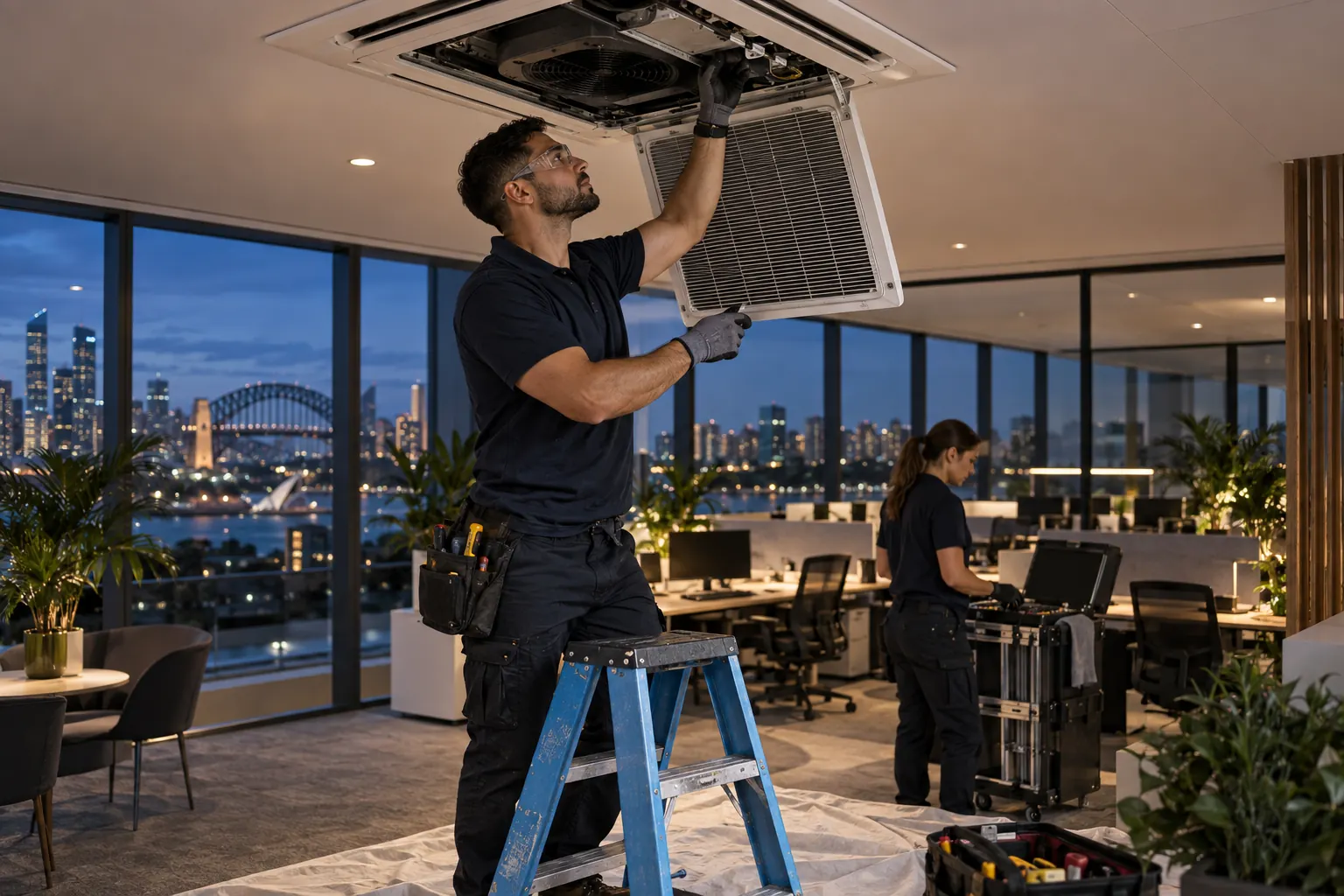
Build a commercial HVAC maintenance or repair scope around assets, tenancy hours, access, faults, records and approval limits. The guide focuses on buying scope and booking evidence, not generic air conditioning theory.
commercial air conditioning Sydney maintenance Starts With the Commercial Outcome
A useful commercial air conditioning Sydney maintenance enquiry begins with the outcome you intend to buy: which rooms must be conditioned, which operating problem must be resolved, and whether the project is installation, replacement, repair or maintenance. Name the Sydney suburb, property type, occupancy and intended timing. For a commercial split, cassette, ducted or VRF equipment, also explain the current comfort pattern rather than asking a provider to choose from floor area alone. This establishes commercial intent without pretending that an online estimate is a final design.
The problem to avoid is reactive failures and unclear asset history. Give the quoting contractor enough evidence to identify the next correct step: photographs, floor plan, model numbers, error codes, room dimensions, operating symptoms, switchboard context and access details. The contractor can then decide whether a site measure, diagnostic attendance or document review must precede a fixed proposal. That approach makes the commercial air conditioning maintenance agreement easier to compare because the assumptions are recorded before equipment and labour are bundled together.
commercial air conditioning Sydney maintenance Room Load and Capacity Inputs
Capacity selection for Sydney conditions should consider the usable dimensions of every conditioned room, ceiling height, window area, glazing direction, shading, insulation, air leakage, occupancy and internal equipment loads. Open doorways and connected spaces can make a nominally small room behave as part of a larger zone. Record when each area is used and whether night-time quiet, fast pull-down or steady daytime operation is the priority. These inputs help a licensed provider test whether the proposed commercial split, cassette, ducted or VRF equipment is appropriately sized.
Oversizing and undersizing can both compromise comfort, control and operating behaviour. A rough watts-per-square-metre shortcut may help an early conversation, but it cannot replace site-specific assessment or manufacturer selection data. Ask the quote to show the capacity of each indoor unit, the combined outdoor capacity where relevant, and any diversity assumption used when several zones operate. For ducted proposals, the relationship between plant capacity, outlets, returns, duct resistance and minimum open-zone airflow should be part of the design conversation.
Open the Sydney air conditioner sizing checklistcommercial air conditioning Sydney maintenance Equipment Selection and Model Schedule
A comparable quote identifies the actual equipment architecture and model schedule. It should distinguish wall split, multi-head, ducted reverse cycle, bulkhead, cassette, VRF or packaged equipment instead of using “air conditioning” as a catch-all. Record indoor-unit and outdoor-unit quantities, rated capacities, controller type, proposed zones and included accessories. If a brand range is nominated before the site is confirmed, ask whether the final model can change after load, route, electrical or availability checks.
Product features should connect to the property decision. Sound ratings matter near bedrooms and neighbours; dimensions matter inside bulkheads and balconies; external static capability matters in ducted design; corrosion protection may matter in exposed positions; control integration can matter in offices and multi-site facilities. Energy labels and manufacturer specifications should be checked for the specific model rather than inferred from a family name. Availability, specification and suitability need confirmation in the written commercial air conditioning maintenance agreement proposal.
commercial air conditioning Sydney maintenance Indoor Unit, Outlet and Return-Air Positions
Indoor equipment needs a position that distributes air through the intended zone without creating a persistent draught, short-circuiting the return path or obstructing furniture and doors. Wall splits require appropriate structure and a realistic route to the outside. Bulkhead and ducted systems add ceiling space, access panels, service clearance, outlet throw, return-air location and acoustic considerations. Ask the installer to explain the position and finish, particularly when the visual result is important to a Sydney terrace, apartment or designed interior.
For ducted systems, count and locate the proposed outlets, identify the return-air grille and state how zones are grouped. A bedroom zone with a closed door still needs an adequate air path. Large west-facing living areas can behave differently from shaded rooms even when floor areas appear similar. The final proposal should make clear whether grille selection, plenums, duct transitions, sealing, insulation, balancing and ceiling alterations are included. Ambiguous outlet counts or generic “whole-home” language make ducted prices difficult to compare.
commercial air conditioning Sydney maintenance Outdoor Unit, Noise and Service Clearance
The outdoor unit requires enough airflow, stable support, drainage management and service clearance. Its location can affect capacity, noise, pipe distance, appearance, neighbour impact and future maintenance access. Sydney apartments may restrict balcony positions or façade changes; terraces can have narrow side access; CBD properties can require plant-room, roof, lifting or loading arrangements. Photograph the preferred position and any alternative so the quote records whether brackets, pads, screens, lifting, roof access or structural input are assumed.
A visually hidden condenser is not automatically a technically suitable condenser. Enclosures, tight alcoves and recirculating hot air can harm performance. Likewise, placing equipment beside bedrooms or boundaries without reviewing sound may create an avoidable problem. Ask how the proposed position follows manufacturer clearance requirements and relevant site rules. If acoustic treatment, screening or approvals are conditional, list them separately rather than allowing them to emerge after acceptance of the commercial air conditioning maintenance agreement price.
commercial air conditioning Sydney maintenance Refrigerant Pipe and Condensate Drain Route
The connection route can materially change a Sydney air conditioning price. State whether the proposal assumes a direct back-to-back split installation, an extended surface-mounted run, a concealed route, ceiling access, core drilling or work across several levels. Ask what pipe length, insulation, cover, penetrations and finish are included, and how additional distance or difficult access will be priced. Multi-split and VRF systems also require branch layouts and manufacturer limits to be checked against the selected equipment.
Condensate must reach an appropriate discharge point with reliable fall or a correctly selected pump arrangement. The route should not be an afterthought, especially for internal apartment rooms, bulkhead units, cassettes and ducted fan coils. Ask whether trays, pumps, tundishes, drains, testing and accessible maintenance points are included. When the enquiry is driven by water leakage, avoid assuming a blocked drain is the only cause: installation fall, icing, damaged trays, pump faults and airflow conditions may require diagnosis.
Compare Sydney air conditioning quote inclusionscommercial air conditioning Sydney maintenance Electrical Work and Switchboard Scope
Record the available supply, nearby circuits, proposed isolator position and any known switchboard limitation. The quote should distinguish air conditioning and refrigeration work from associated electrical tasks and identify who is responsible for each component. New installations, larger replacements and commercial plant may require a dedicated circuit, protection changes, control cabling, supply upgrades or coordination with another appropriately licensed trade. Do not assume that the equipment price includes all required electrical work.
For a repair enquiry involving tripping power, burning smell, damaged cabling, water near electrical components or unreliable isolation, continued resetting can be unsafe. Switch off equipment where appropriate and arrange competent assessment. A diagnostic visit should separate the observed symptom from the confirmed cause, then provide an approval path for parts and additional labour. The written record should show what was tested and whether the commercial split, cassette, ducted or VRF equipment operated after the approved work.
commercial air conditioning Sydney maintenance Sydney Access, Strata and Building Approvals
Access belongs in the price brief. Note parking, loading zones, stairs, lift booking, ceiling hatches, roof permits, working-height needs, restricted hours, tenant coordination and protection of finished surfaces. Sydney CBD, apartment and hospitality jobs can require staged work or building-management documents. A low equipment price can become poor value if lifting, access, making good or after-hours requirements were never included. Provide building rules early and ask the provider to state assumptions that depend on a separate contractor or approval.
Apartment and strata work may involve common property, penetrations, condenser appearance, balcony drainage, acoustic requirements and approved working times. Landlord or fit-out approvals may apply in commercial premises. The quoting contractor can supply relevant technical information, but the proposal should say who obtains each approval and what happens if the preferred route is refused. Do not schedule installation until dependencies are sufficiently clear for the building and the contracted commercial air conditioning maintenance agreement scope.
commercial air conditioning Sydney maintenance Price Breakdown, Allowances and Exclusions
Ask for a written price structure that is meaningful for the job. Depending on the project, it may separate equipment, standard labour, extended pipework, ductwork, zones, controls, brackets, condensate pumps, electrical work, access equipment, removal, disposal, patching and after-hours activity. Allowances and provisional items should state their basis and approval mechanism. The objective is not maximum line-item complexity; it is to reveal material assumptions so two Sydney quotes can be evaluated on comparable scope.
Common exclusions can include switchboard upgrades, asbestos or hazardous-material management, structural engineering, painting, joinery, builder patching, authority fees, strata approvals, roof remediation and latent conditions. Confirm whether old equipment and redundant services are removed and whether penetrations are sealed or made good. A headline package may still be appropriate when the property matches every stated condition. If the conditions are missing, request clarification before accepting the commercial air conditioning maintenance agreement offer.
commercial air conditioning Sydney maintenance Contractor Licence and ARCtick Verification
Before accepting regulated work, verify the contracting party and relevant NSW licence through the official government licence-check channel. Air conditioning and refrigeration work is specialist work in NSW, and associated electrical work has its own licensing boundaries. Match the name and number on the proposal with the entity you intend to contract. An advertisement, logo or first name is not a substitute for that verification. Also confirm who will supervise and complete each part of the commercial split, cassette, ducted or VRF equipment scope.
The Australian Refrigeration Council administers the national scheme for refrigerant handling licences and refrigerant trading authorisations. Check the relevant ARCtick credentials where regulated refrigerant work is involved. This AirMetric website is a development preview and deliberately makes no claim that a real contractor is licensed. Legal entity, contractor licence, refrigerant authorisation and telephone fields remain marked as launch requirements, preventing attractive design from manufacturing trust evidence that has not been supplied.
commercial air conditioning Sydney maintenance Commissioning, Handover and Maintenance
Commissioning connects installed components to the purchased comfort outcome. Relevant checks can include operating modes, controller functions, temperature response, drainage, visible pipe and cable finish, fan operation, outdoor-unit behaviour and error status. Ducted systems may add zone response, outlet airflow, return-air behaviour and balancing. The exact process depends on the system, but a written proposal should not treat “installed” as the last meaningful word. Ask what test record and customer handover are included.
Handover should identify the installed models, controller operation, filter access, cleaning expectations, maintenance intervals, documents and any known limitation. For commercial sites, build an asset register and align service access with trading hours. For replacement work, record which existing ducts, grilles, drains, circuits or controls remain and their assessed condition. These details help future service providers understand the installation and reduce the chance that every repair visit starts without history.
Request a commercial air conditioning Sydney maintenance Site Assessment
Turn the research into a commercial brief. Select the property type and Sydney suburb, list rooms or conditioned areas, identify the existing and preferred system, describe reactive failures and unclear asset history, and attach floor plans or photographs. Add access, outdoor-unit, drainage, electrical, strata and scheduling information. State whether you need supply and installation, labour-only work, replacement, diagnosis, repair or planned maintenance. The clearer the desired purchase, the more efficiently a provider can choose the correct next step.
The initial online brief is not a final capacity calculation, technical design, diagnosis or contract. Use it to arrange the assessment needed for a written proposal. Before acceptance, confirm the legal contractor, licences, authorisations, scope, equipment, price, assumptions, exclusions, approvals, timing, payment terms, commissioning and applicable consumer protections. That is the practical purpose of this commercial air conditioning Sydney maintenance guide: moving from a broad search phrase to a defined Sydney air conditioning decision.
Turn This commercial air conditioning Sydney maintenance Research Into a Sydney Quote
Send the rooms, system, property, access and approval evidence. Use the response to arrange diagnosis or assessment, then compare the written scope before acceptance.
Build the Sydney air conditioning brief